
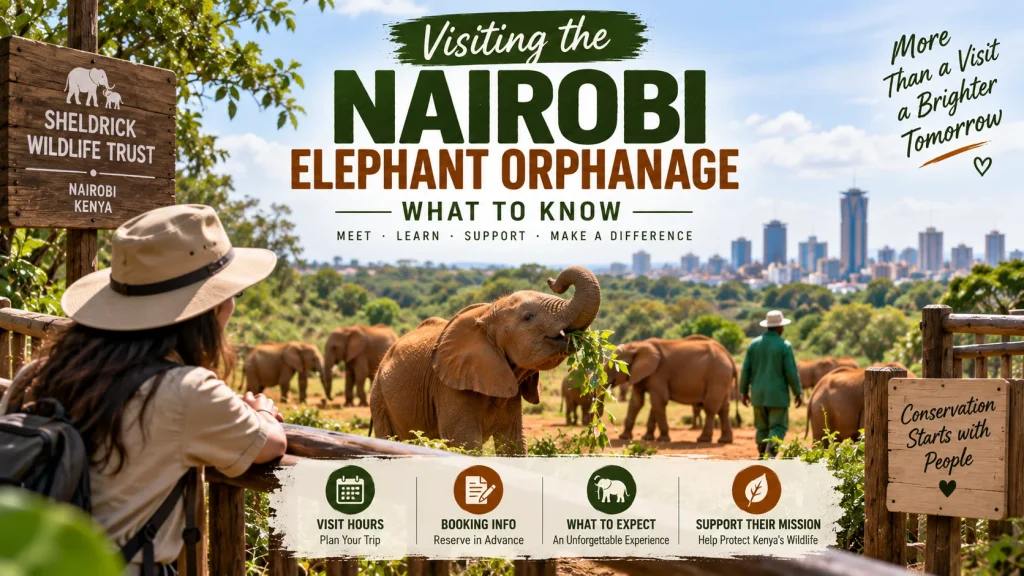
Quick answer: The Nairobi elephant orphanage is the Sheldrick Wildlife Trust (SWT) Nursery, located inside Nairobi National Park and open to the public for one hour daily, 11am to 12pm. Advance booking is required directly through SWT, and you’ll pay two separate fees — a Nursery entry donation and a separate Kenya Wildlife Service park entry fee — which is the single most common thing visitors get caught out by.
This is one of the most popular half-day activities we arrange for guests spending a night in Nairobi before or after a safari, and it’s also one of the easiest to get slightly wrong if you’re planning it yourself. Between the strict one-hour window, the advance booking requirement, and a fee structure that catches even experienced travelers off guard, a bit of preparation goes a long way. Here’s exactly what to know.
What the Nairobi Elephant Orphanage Actually Is
The Sheldrick Wildlife Trust Nursery is where every rescued elephant’s journey begins. Orphaned elephants — most having lost their mothers to poaching, drought, human-wildlife conflict, or falling into wells — are brought here from parks and reserves across Kenya, hand-raised by a dedicated team of Keepers, and eventually reintegrated into the wild through SWT’s reintegration units in Tsavo and the Kibwezi Forest. Founded through the work of the late Daphne Sheldrick, a globally recognized pioneer in elephant rehabilitation, SWT’s Orphans’ Project has raised more than 320 orphaned elephants and rhinos since it began.
It’s worth knowing there’s a second, separate facility — the KWS Nairobi Animal Orphanage near the park’s Main Gate — which is a different place entirely and is currently being relocated to make way for a new convention centre. If someone mentions “the Nairobi orphanage” and you end up somewhere unexpected, this mix-up is almost always why. The SWT Nursery, which this guide covers, is not moving and is not affected.
Visiting Hours & Booking Rules
The public visit runs for exactly one hour, from 11am to 12pm, every day of the year except December 25th. During this window, you’ll watch the Nursery orphans take their midday milk feed and mud bath from designated viewing platforms, with a senior Keeper leading the visit and answering questions.
- Advance booking is required — this is not a walk-up attraction, and there is no guarantee of entry without a confirmed booking
- Bookings must be made directly through SWT’s official Nairobi office or website — third-party bookings are explicitly not accepted
- The visit cannot be delayed or extended for late arrivals, so arriving by around 10:45am is worth building into your plan
- Gates can move quickly once they open, so allow extra time getting through the KWS Mbagathi Gate beforehand
Entry Fees: The Part Most Visitors Get Wrong
This is the detail that trips up more visitors than anything else: because the SWT Nursery sits inside Nairobi National Park, you pay two completely separate fees to two separate organizations — and paying one does not cover the other.
| Fee | Amount | Paid To |
| SWT Nursery entry donation | USD 20 (or KES 2,000 for citizens) | Sheldrick Wildlife Trust, on arrival |
| KWS Nairobi National Park entry fee | USD 80 non-resident / USD 40 African citizen / KES 1,350 resident / KES 1,000 EA citizen | Kenya Wildlife Service, via kwspay.ecitizen.go.ke |
A roughly 5% KWS payment gateway fee also applies on the park entry portion. Several of our own guests have told us the non-resident park fee felt steep just for a one-hour visit if they weren’t also doing a Nairobi National Park game drive — which is exactly why we usually recommend combining the two rather than visiting the orphanage in isolation, so the park fee is doing double duty rather than paying for access alone.
KWS park fees are paid entirely separately from the SWT donation and cannot be processed by SWT staff, so budget for both and don’t assume one payment covers everything.
The Story Behind Sheldrick Wildlife Trust
The trust takes its name from David Sheldrick, the founding warden of Tsavo East National Park, and was established by his wife, Daphne Sheldrick, who went on to become the world’s foremost authority on the successful hand-rearing of orphaned elephants. Raising an orphaned elephant is notoriously difficult — elephants are deeply dependent on their mothers for years, and early conservation efforts lost nearly every orphan they tried to save, largely because no one had figured out a milk formula infant elephants could actually digest. Daphne Sheldrick spent decades perfecting one, and that breakthrough is the reason organizations like SWT can successfully raise orphans to adulthood today rather than simply providing short-term care.
What began as one family’s conservation work has grown into one of the most respected wildlife rescue operations in Africa, now running anti-poaching, veterinary, and habitat protection programs well beyond the Nursery itself. Visiting the Nursery is a small window into a much larger operation working across Kenya’s protected areas.
What Actually Happens During Your Visit
Once inside, visitors gather around a roped-off red-earth clearing where Keepers bring the orphans out in small groups by age, youngest first. Each elephant gets its bottle of specially formulated milk, often finishing it in under a minute before tumbling into the mud wallow that gives the visit its reputation as one of the most joyfully chaotic wildlife encounters in Kenya — orphans genuinely play, wrestle, and clamber over each other and occasionally over visitors’ feet at the rope line. A Keeper narrates throughout, sharing each elephant’s individual rescue story: where it was found, how long it’s been at the Nursery, and its particular personality quirks, since every orphan genuinely does have one. It’s a far more personal, story-driven experience than a typical wildlife viewing, which is part of why it leaves such a strong impression on most visitors.
From Rescue to the Wild: What Happens After the Nursery
The Nursery is only the first stage of a years-long journey. Newly rescued elephants, sometimes only weeks old, stay at the Nairobi Nursery until they’re old enough — typically around age two to three — to move to one of SWT’s reintegration units in Tsavo (at Voi or Ithumba) or Umani Springs in the Kibwezi Forest. There, orphans are gradually introduced to wild elephant herds during supervised daytime outings, while still returning to Keeper care at night, over a process that can take several more years. Eventually, most orphans choose to leave permanently and rejoin wild herds, sometimes returning years later, as adults, to introduce their own wild-born calves to the Keepers who raised them — one of the details that visitors and Keepers alike find most moving about the program.
Getting There
The SWT Nursery is accessed via the KWS Mbagathi Gate, also called the KWS Workshop Gate, off Magadi Road on the southern edge of Nairobi National Park — not the park’s main entrance. If you’re arranging your own transport, confirm your driver knows this specific gate, since it’s a common point of confusion even for local taxi drivers unfamiliar with the distinction from the park’s Main Gate. Traffic on Magadi Road can be unpredictable during Nairobi’s morning rush, so building in a buffer of at least 30-45 minutes beyond your estimated drive time is a reasonable precaution if you’re self-driving or using a ride-hailing app rather than a dedicated safari vehicle.
Combining It With Other Nairobi Activities
Because the visit is only an hour and falls in the late morning, it pairs naturally with other short Nairobi activities either side of it — a morning game drive in Nairobi National Park beforehand, since you’ll already be paying the park entry fee, or an afternoon stop at the Giraffe Centre, a short drive away. Many of our guests build this into an arrival-day or departure-day itinerary in Nairobi, turning what could be dead time before a flight into a genuinely memorable few hours. A common pattern we build for guests: an early morning Nairobi National Park game drive from around 7am, followed by the 11am orphanage visit, then lunch and a short rest before an afternoon flight or departure toward the Masai Mara or another park.
If your schedule allows a full day in Nairobi rather than just a morning, the Giraffe Centre and the nearby Karen Blixen Museum (of Out of Africa fame) both sit within a similar radius and are commonly combined into the same day trip.
Tips for Making the Most of Your Hour
- Arrive by 10:45am — the visit starts promptly and isn’t extended for late arrivals
- Bring a camera with a reasonably fast shutter speed; the orphans move quickly, especially during the mud bath
- Stand slightly back from the busiest section of the rope line if you want a clearer, less crowded photo angle — the Keepers often bring individual orphans closer to quieter spots
- Wear closed shoes and clothing you don’t mind getting a little dusty — this is a working rescue facility, not a manicured attraction
- Ask questions — the Keepers are genuinely knowledgeable about each orphan’s story and welcome them during the visit
Adopting or Fostering an Orphan
If the visit leaves an impression — and for most people, it does — SWT runs a foster program where you can “adopt” a specific orphan for USD 50 per year, separate from the entry fee. Foster parents also gain access to a private, less crowded visit at 5pm, an option worth knowing about if the busy midday session isn’t appealing. The Nursery herd changes over time as orphans grow and graduate toward reintegration and new rescues arrive, so rather than naming specific residents here, we’d point you to SWT’s own website for who’s currently at the Nursery closer to your visit date.
Why This Work Matters
Most of the orphans arriving at the Nursery today are victims of drought, human-wildlife conflict, or falling into wells and pit latrines rather than poaching directly, reflecting how Kenya’s elephant conservation challenges have shifted over the past two decades. Poaching-driven population crashes in parks like Tsavo during the 1970s and 1980s pushed Kenya’s elephant numbers to crisis lows, and while dedicated anti-poaching work has allowed populations to recover significantly since then, elephants and expanding human settlements now compete for the same land and water more often than in the past. Every visit’s entry donation goes directly toward funding this ongoing work — Keeper salaries, veterinary care, anti-poaching patrols, and habitat protection — making it one of the more meaningful ways to combine tourism with real conservation impact during a short Nairobi stay.
Is It Ethical? A Fair Question to Ask
Wildlife tourism attracts justified skepticism, and it’s a fair question to ask before booking anything involving animals. A few things distinguish SWT’s model from the kind of exploitative wildlife attractions worth avoiding: orphans are genuinely rescued, not bred or captured for tourism; there’s no physical contact between visitors and elephants, no riding, and no forced interaction; the entire program is oriented toward eventual wild release rather than permanent captivity; and the visiting hour itself is short, tightly controlled, and structured around the elephants’ actual daily routine rather than performances staged for visitors. The one-hour public window exists specifically so tourism revenue can fund the work without disrupting the orphans’ care schedule or wellbeing. It’s a genuinely different model from attractions where elephants are kept for entertainment, and it’s worth understanding that distinction rather than assuming all elephant encounters in Kenya are the same.
Frequently Asked Questions
What are the visiting hours for the Nairobi elephant orphanage?
The Sheldrick Wildlife Trust Nursery is open to the public for one hour daily, from 11am to 12pm, every day except December 25th.
How much does it cost to visit the Nairobi elephant orphanage?
You’ll pay two separate fees: a USD 20 SWT Nursery entry donation, plus a separate Kenya Wildlife Service park entry fee (USD 80 for non-residents), since the Nursery sits inside Nairobi National Park.
Do I need to book in advance to visit the elephant orphanage?
Yes — advance booking directly through SWT’s official Nairobi office or website is required, and third-party bookings are not accepted. Walk-ins are not guaranteed entry.
Is the Nairobi elephant orphanage the same as the KWS Animal Orphanage?
No — these are two different facilities. The Sheldrick Wildlife Trust Nursery, covered in this guide, is separate from the KWS Nairobi Animal Orphanage near the park’s Main Gate, which is currently being relocated.
Can you adopt a baby elephant at the Nairobi orphanage?
Yes — SWT’s foster program lets you adopt a specific orphan for USD 50 per year, separate from the visit entry fee, and includes access to a private 5pm viewing.
How do you get to the Sheldrick Wildlife Trust Nursery?
Access is via the KWS Mbagathi Gate (also called the KWS Workshop Gate) off Magadi Road, on the southern side of Nairobi National Park — not the park’s Main Gate.
What happens to the elephants after they leave the Nairobi Nursery?
Around age two to three, orphans move to SWT’s reintegration units in Tsavo or the Kibwezi Forest, where they’re gradually reintroduced to wild herds over several more years before most eventually rejoin wild elephant populations permanently.
Is the Nairobi elephant orphanage worth visiting?
Yes — it’s a genuinely moving, well-run experience that combines close wildlife viewing with real conservation education, and it works especially well as a half-day activity on an arrival or departure day in Nairobi.
A Small Addition With a Big Impact
For a trip built mostly around wide-open landscapes and distant sightings through binoculars, the orphanage visit stands out precisely because it’s the opposite — close, personal, and unhurried, over almost as soon as it begins. Guests who add it to a Nairobi stopover consistently tell us it becomes one of the trip’s most talked-about hours, not despite being brief, but partly because of it. If you’re weighing whether an extra half-day in Nairobi is worth it before or after your safari, this is usually our answer.
Add This to Your Kenya Itinerary
We build the elephant orphanage visit into many of our Nairobi arrival and departure days, alongside a Nairobi National Park game drive. If you’re planning your wider itinerary, our guide to Kenya’s national parks is a good next stop, or get in touch and one of our Maasai guides will help you fit this into your Kenya trip.