
A Maasai village visit usually costs US$20 to US$50 per person, lasts anywhere from 30 minutes to about two hours, and includes a welcome song, the famous jumping dance, a look inside a traditional house, and a craft market. The fee should go to the community, so ask who receives it before you pay. Ask before you photograph anyone, and treat it as a visit to someone’s home, not a show.
If you’re planning a safari in Kenya, a Maasai village visit has probably shown up in your itinerary already, usually as an optional extra on the day between game drives. It’s also one of the most debated parts of any trip. Some travelers call it the highlight of their safari. Others leave feeling they watched a performance and were sold a bracelet. Both reactions are real, and the difference usually comes down to how the visit is arranged and what you bring to it.
We’re a Maasai-owned safari company, so we’ll be straight with you. This guide explains what a Maasai village actually is, what happens during a visit, what it costs in 2026, how to tell a genuine visit from a tourist trap, and how to behave so your hosts feel respected. One quick note on spelling: the Maasai are also written as Masai, which is why you’ll see both “Maasai village” and “Masai village” online. They mean the same thing.
What Is a Maasai Village, Really?
The Maasai are a Maa-speaking, semi-nomadic pastoralist people of southern Kenya and northern Tanzania, and cattle sit at the center of their way of life. Kenya’s 2019 census counted about 1.19 million Maasai in the country, living mainly in counties such as Narok and Kajiado, around the Masai Mara and Amboseli.
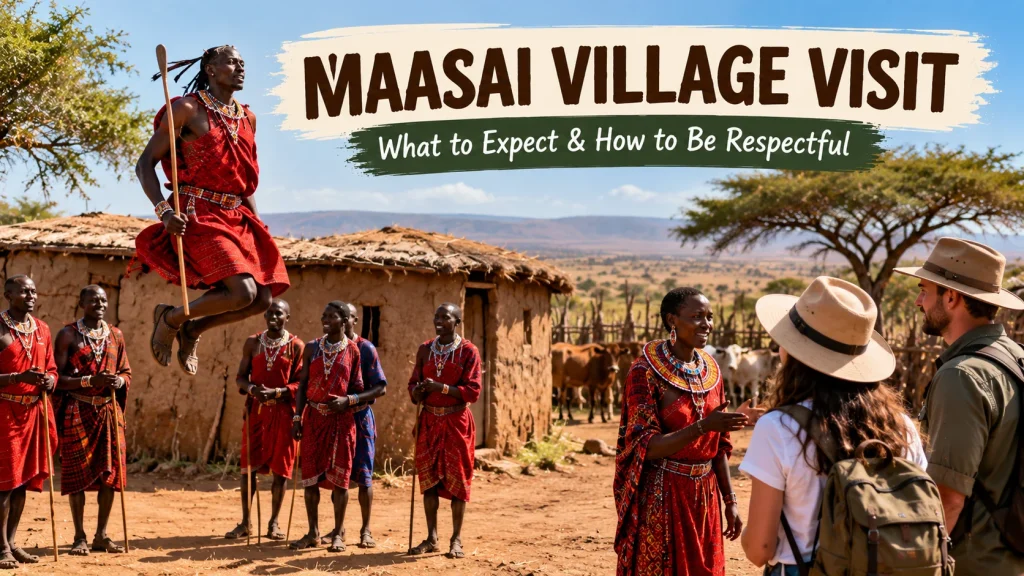
What visitors call a Maasai village is usually a family homestead: a ring of small houses made of sticks, mud, grass and cow dung, inside a fence of thorn branches, with a central enclosure where the cattle are kept at night. It’s often called an enkang in Maa. A homestead can shelter several related families, and traditionally the houses are built by the women.
This matters for how you visit. “Village” is the traveler’s word. For the people who live there, it’s home. Some Maasai villages are set up specifically to host guests, and others are everyday homesteads that open their doors at set times in return for a fee that supports the community. A good Maasai village visit starts with understanding that you’re being invited in, not entering an attraction that exists only for you.
What Happens During a Maasai Village Visit
Every community runs its visit a little differently, but most follow a familiar order.
- The welcome. Residents usually greet you at the entrance, often with singing, and your host explains how the visit will go. This is a good moment to ask your host’s name and say thank you. A simple greeting goes a long way.
- The jumping dance (adumu). Young men in red shukas line up and take turns leaping high on the spot, keeping their bodies straight, while others sing. Traditionally it’s a display of strength and stamina by warriors, and it belongs to ceremonies as well as to visitors. The version you’ll see is usually a shorter welcome performance. You may be invited to join in, and a few awkward jumps from guests are always welcome and usually get plenty of laughter.
- A walk through the homestead. Your host explains daily life: how cattle are herded, how the houses are built, who does which work, and how age-sets organize a person’s role in the community from boyhood to elderhood. This is the part to ask questions in.
- Inside a house. You’ll usually be invited into one of the houses. It’s small, low and dim inside, so take your time letting your eyes adjust and mind the doorway.
- The livestock enclosure. Cattle, goats and sheep are the heart of the homestead, so your host may show you where they’re kept and explain what they mean to the family.
- The craft market. Most visits end with beadwork and carvings laid out for sale, much of it made by the women of the community. Buying is optional, and we’ll cover how to handle it below.
- Sometimes a school or clinic. Depending on the community, the visit may also include a short stop at a local school or health facility that the fees help support.
Most visits run about an hour. Depending on the village and the program, they can be as short as 30 minutes or stretch past two hours. If you want more conversation and less scripted performance, tell your guide before you go, because the length and style are often flexible.
How Much Does a Maasai Village Visit Cost?
Prices vary by village, by how the visit is arranged, and by whether your lodge or camp is organizing it. Here are the figures most commonly quoted for the Masai Mara area in 2025 and 2026:
| What you pay for | Typical cost | Worth knowing |
| Village entry fee (arranged by your guide or operator) | US$20 to US$30 per person | Often around KES 2,500, or about US$20, and usually paid in cash |
| Visit arranged through a camp, or after a fly-in package | US$30 to US$50 per person | Higher because camps usually add their own transfer and arrangement costs |
| Photos | Free to a few dollars per photo | Practice varies by village, so agree before you start |
| Souvenirs and beadwork | About US$5 to US$30 | Prices are negotiable, and buying is optional |
| Tip for your village host | Small amounts are appreciated, often around US$5 | Optional, and best given directly to your host |
For reference, our 3-day budget camping safari lists the Maasai village visit as an optional extra at US$20 per person, which sits at the lower end of the usual range. Prices change, so confirm the current figure when you book.
Two practical tips. First, bring small notes, because change can be hard to find in a village and a large bill leaves everyone in an awkward spot. Second, remember what the fee is for: it’s an entry contribution that supports the community hosting you, and it sometimes covers your transfer. It isn’t a tip for the dancers, so it’s always fair to ask how it’s shared.
Ethical Maasai Village Visit or Tourist Trap?
Not every visit is equal, and the difference shows up in a few predictable places. Here’s how to tell them apart:
| Signs of a good visit | Warning signs |
| You know the name of the community or conservancy before you go | The itinerary just says “visit a Maasai village” with no further detail |
| Your operator can explain who receives the fee and how it’s shared | Nobody can say where your money goes |
| Hosts introduce themselves and welcome real questions | A rushed, scripted routine with no time to talk |
| The pace is relaxed and the group is small | Several tour groups arrive at once and you’re hurried through |
| The craft market is low-pressure and the makers sell directly | Aggressive selling begins the moment you arrive |
| Photo rules are explained clearly at the start | Photo charges are demanded after the fact |
Before you book anywhere, these are fair questions to put to your operator:
- Which community or village will we visit?
- Who receives the fee, and how is it used?
- Is the visit arranged with the community’s agreement?
- How many groups visit in a day?
- Can we have more time for conversation and fewer scripted parts?
- What are the photo rules?
In some conservancies, cultural visits are organized by the landowning community itself, which can make fee-sharing more transparent. It’s worth asking your operator whether that option exists where you’re staying.
Maasai Village Etiquette: How to Be Respectful
Most of this is ordinary good manners, adjusted for the fact that you’re a guest in someone’s home.
Greet before you do anything else. A hello and a thank you open the visit on the right note. Show particular respect to elders, and let your host guide you on how to greet them.
Ask before photographing people. Always ask, even when photography is part of the arrangement, and agree on any photo payment beforehand so there are no surprises. Asking about photos of homes and animals is polite too.
Dress comfortably and modestly. Covered shoulders and knees and closed shoes are sensible, since the ground is uneven and livestock are close by.
Don’t treat it like a zoo. Wait to be invited into houses, don’t point cameras at people from a distance without interacting, and put your phone away for part of the visit. You’ll learn more with your hands free.
Be careful with children. Avoid handing out money or sweets, which can encourage begging and isn’t what the community asked for. If you want to contribute something, give it through the elder or the school.
Buy because you like it, not out of guilt. Purchases support the makers, but there’s no obligation. Bargaining politely is normal, as long as it stays good-natured, and buying directly from the person who made an item is best.
Ask real questions. How do the age-sets work? How are the houses built? What does a normal day look like? Hosts usually enjoy being asked something beyond “can I take your photo.”
Is Visiting a Masai Village Worth It? An Honest Answer
For most travelers, yes, as long as you go with the right expectations. It’s worth it if you want to understand the people who have lived alongside this landscape for generations, and if the visit is arranged with transparency. It’s less worth it if you’re hoping for a spontaneous, unfiltered encounter. A visit with a schedule is arranged by definition, so think of it as an introduction that opens a door rather than the whole conversation.
It’s also optional. If your safari is already packed with game drives, or you prefer not to attend set performances, skipping it is a perfectly reasonable choice. And if you do go, a few things make it better: choose a community-run option, keep the group small, and ask for time to talk, not just to watch. Many travelers tell us the best moments come from simply sitting and asking questions.
There’s another route too. Our guides are Maasai, and many grew up in the landscape you’re driving through. Ask yours to share what they know on the road: how to read tracks, which plants are used for what, and what the land means to the people who live on it. That kind of conversation often teaches as much as a scheduled visit.
Three Myths About the Maasai Village Visit
“A Maasai village is a museum frozen in time.” It’s a living community. Maasai people live in rural homesteads and in towns, speak Swahili and English as well as Maa, and many combine herding with other work. A homestead is a home, not an exhibit.
“The jumping dance is made up for tourists.” The adumu is a long-standing tradition tied to young warriors and to ceremonies. What visitors see is a shorter welcome version of something that’s genuinely part of Maasai life.
“You’re paying for access to a culture.” The fee is an exchange. It supports the community that’s hosting you, which is exactly why it’s worth asking where it goes.
Planning a Maasai Village Visit Into Your Safari
Where. Villages that welcome visitors are found around the Masai Mara, often near the reserve gates, and in other Maasai areas such as around Amboseli.
When. It’s usually arranged as an add-on during a full Mara day, between game drives, and it fits easily into any Masai Mara safari of two nights or more. It runs year-round.
How. Ask your operator to arrange it, and ask early if you want a longer visit or a specific community. On our Masai Mara safaris it’s an optional extra, listed on our 3-day budget camping safari and available on our 3-day Jambo Lodge safari. We’re happy to tell you in advance which community you’d be visiting and how the fee is shared.
If you’re still working out how long to stay, our guide on how many days you need in the Masai Mara will help you fit a village visit in without rushing. For the practical side, see our Kenya safari tipping guide and our list of 17 Kenya safari mistakes to avoid.
Frequently Asked Questions
How much does a Maasai village visit cost?
Most visits cost US$20 to US$50 per person. Visits arranged directly or by your guide tend to sit at US$20 to US$30, while those arranged through a camp or fly-in package are often US$30 to US$50. On our 3-day budget camping safari it’s listed at US$20 per person.
How long does a Maasai village visit take?
Most visits take about an hour, though depending on the village and program they can run from around 30 minutes to two hours or more.
Is visiting a Maasai village ethical?
It can be, when the fee reaches the community, the visit is arranged with their agreement, and you can ask questions and take your time. Ask your operator which village you’ll visit and who receives the fee.
Can you take photos at a Maasai village?
Yes, with permission. Always ask before photographing a person, and agree on any photo payment before you start, since practice varies from village to village.
What happens during a Masai village visit?
You’re usually welcomed with singing, shown the jumping dance, walked through the homestead, invited into a traditional house, shown the livestock enclosure, and then taken to a craft market. Some visits include a school or clinic stop.
Do I need to book a Maasai village visit in advance?
It’s usually arranged through your safari operator as an add-on. Ask early if you want a longer visit or a specific community.
What should I wear to a Maasai village?
Comfortable, modest clothing with covered shoulders and knees, and closed shoes, since the ground is uneven and livestock are close by.
Where can you visit a Maasai village in Kenya?
Villages that welcome visitors are found around the Masai Mara, often near the reserve gates, and in other Maasai areas such as around Amboseli.
Is a Maasai village visit worth it?
For most travelers, yes, if you go with realistic expectations and the visit is arranged transparently. It’s optional, so you can skip it if your safari is already full.
Plan Your Safari With a Maasai-Owned Team
We build every itinerary around your dates and interests, including a respectful Maasai village visit if you’d like one. Browse our Masai Mara safari packages or get in touch and one of our Maasai guides will help you plan it.